|
WxLog V1
Cloud seeding (weather modification) evaluation and optimisation.
Platform
Windows, macOS, Linux
Single compiled executable
Offline, hardware locked licence
Licensing
Proprietary, single seat to site
Offline, hardware locked
Documentation on request
Request a quote or evaluation →
|
WxLog V1 is an offline desktop application for post-operation evaluation
and optimisation of cloud seeding programmes. It takes raw data (gauges,
grids, radar, trajectories) through rigorous
statistical analysis to publication quality PDF
reports, answering whether seeding produced a statistically significant
increase in precipitation and quantifying the additional water yield, with a
zero knowledge privacy architecture.
How it works
The core question in weather modification is a counterfactual one: how much
rain would have fallen without seeding. WxLog V1 answers it by comparing
seeded target areas against unseeded control areas, then layering modern
causal inference and radar and trajectory evidence on top of the classic WMO
statistics. Every step is logged to an immutable audit trail, and all
operational data stays encrypted on the analyst machine, so the tool is safe
to run fully offline or air gapped.
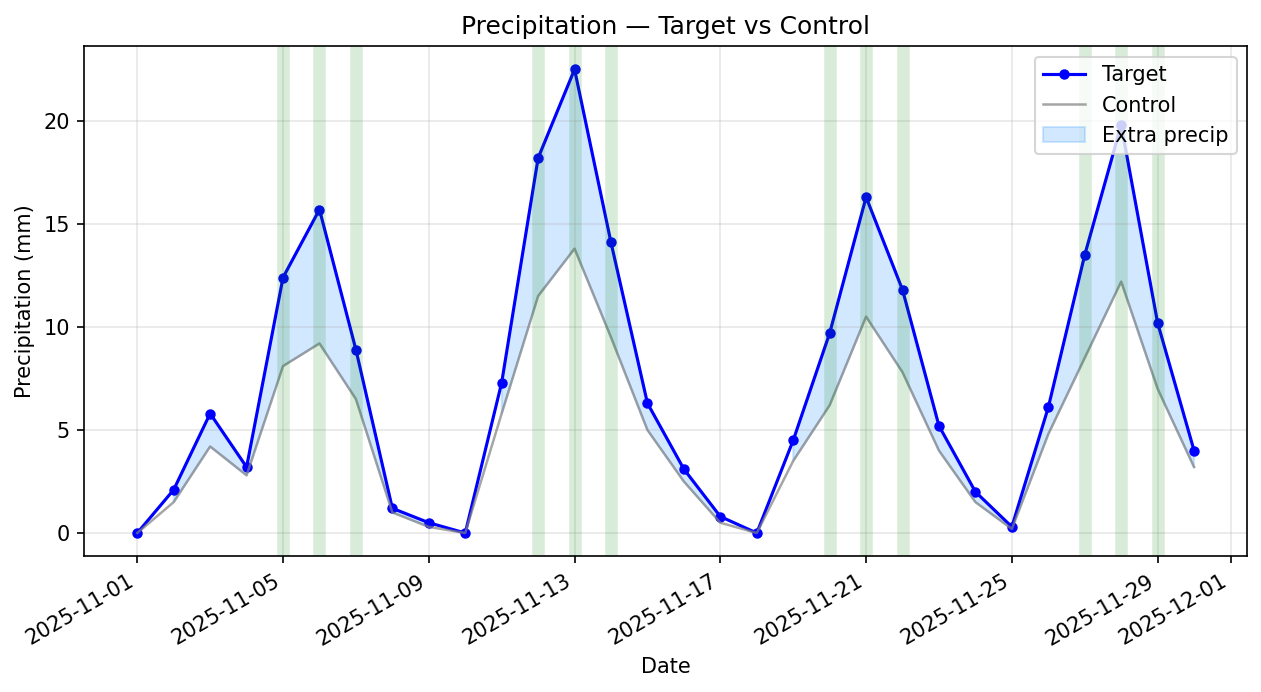
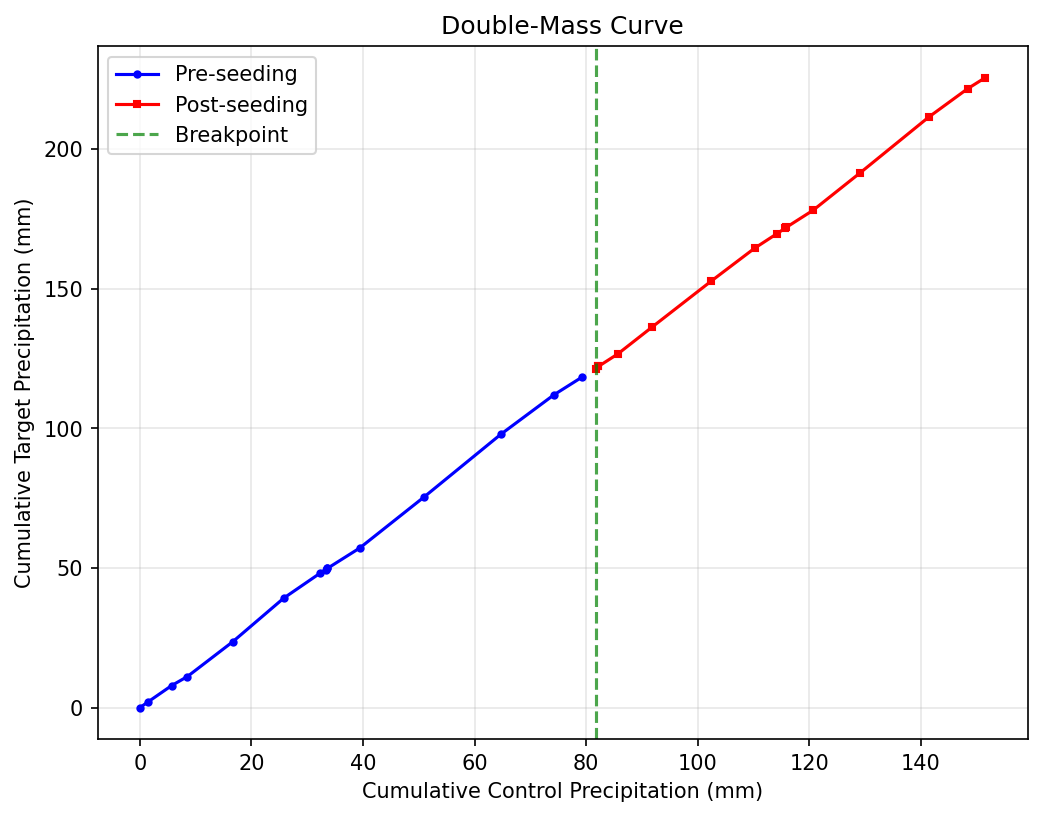
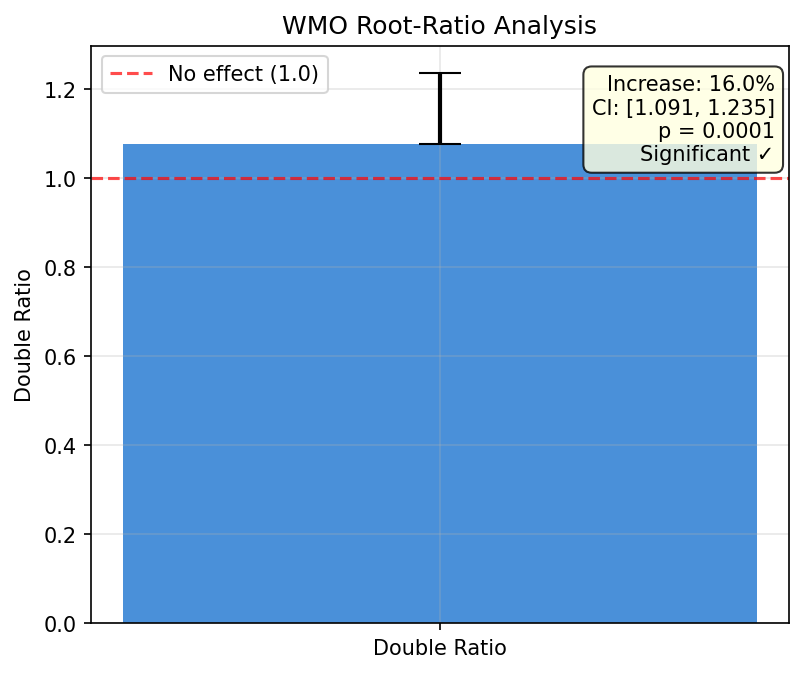
| [ Classic tests ] | Target and control OLS regression, double mass curve, permutation and ratio tests, and the WMO root ratio method. |
| [ Causal inference ] | Propensity score matching and Bayesian structural time series for counterfactual estimation. |
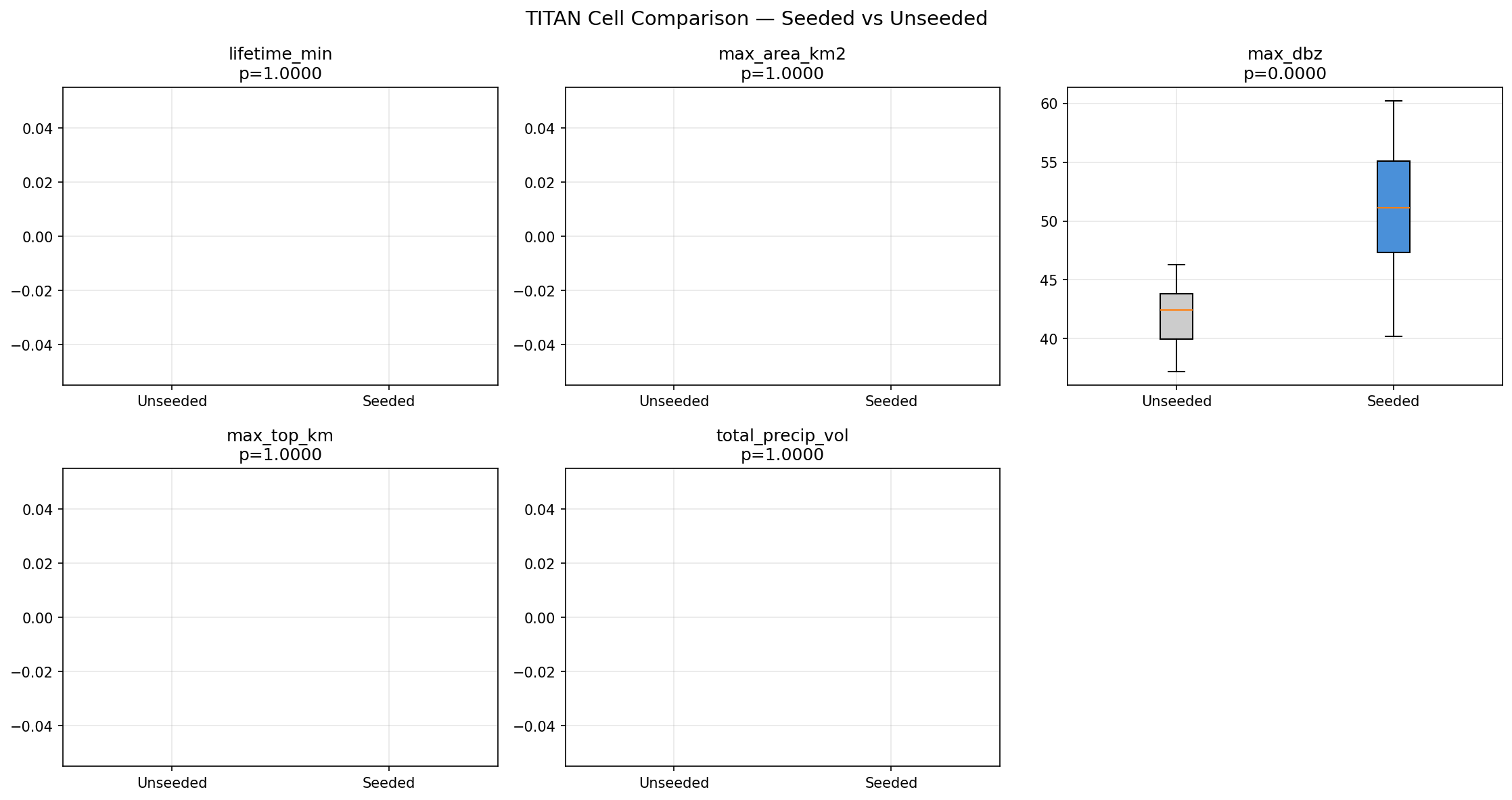
| [ Radar and air ] | TITAN radar cell track comparison and HYSPLIT trajectory delivery scoring to keep only well delivered seeding days. |
| [ Spatial ] | Gauge quality control, Thiessen polygons, inverse distance weighting and ordinary kriging. |
| [ Visualisation ] | Radar visualisation (PPI, CAPPI, volume) with GIF and MP4 export, and NWP and ERA5 forecast import. |
| [ Economics ] | Seedability prediction, what if simulator, network optimiser and Monte Carlo lifetime value (NPV, IRR, benefit cost ratio). |
| [ Compliance ] | WMO, GAO and ASCE compliance auditing, immutable audit trails, and one click PDF and funding proposal reports. |
| [ Privacy ] | Zero knowledge privacy: AES-256-GCM field level encryption and FIDO2 or WebAuthn login. Fully offline and air gap safe. |
The cloud seeding validation challenge
The hardest part of weather modification is not seeding the cloud, it is
proving what the seeding actually did. Clouds evolve on their own, so
separating a human-induced change in rainfall from ordinary natural
variability is genuinely difficult. This has been the central problem since
the first experiments in the 1940s: commercial operators reported success
while controlled scientific projects kept landing in what one review called a
statistical no man's land of inconclusiveness. Radar helps, but it has real
limits.
| [ Natural variability ] | Rain falling downwind may have come from a natural shift in the weather, not the seeding. Radar alone cannot prove the difference. |
| [ Microphysics ] | Radar measures reflectivity and drop size, but it cannot directly watch a silver iodide or nanoparticle nucleus turn a droplet into ice. |
| [ Detection limits ] | Ground and airborne radars are limited by range, the earth's curvature and signal attenuation in heavy rain, so a seeding signature can be missed. |
| [ What radar can show ] | A localised reflectivity enhancement (the seeding signature) along the wind, a lowering of the height of maximum reflectivity, or precipitation weakening in suppression work. |
How WxLog V1 solves these pain points
WxLog V1 is built specifically to close this evidence gap. Rather than rely
on a single radar signature, it estimates the counterfactual, what the
atmosphere would most likely have done without seeding, and then tests the
seeded outcome against it with several independent methods so the conclusion
does not rest on any one assumption.
| [ Natural variability ] | Target and control design, the WMO root ratio, double mass curves and permutation tests, reinforced by causal inference (propensity score matching and Bayesian structural time series) that models the natural counterfactual directly. |
| [ Delivery, not just seeding ] | TITAN radar cell tracking and HYSPLIT trajectory delivery scoring keep only the days where the agent was actually carried into the target cloud, removing the days that muddy every naive analysis. |
| [ Ground truth ] | Radar signatures are backed by physical measurements: gauge quality control, Thiessen, inverse distance weighting and kriging tie the signal to rain that actually reached the ground. |
| [ Model the natural cloud ] | NWP and ERA5 import plus seedability prediction reproduce the modern approach of pairing radar with numerical models and AI to simulate what the cloud would have done on its own. |
| [ Defensible and auditable ] | WMO, GAO and ASCE compliance auditing, immutable audit trails and one click PDF reports turn a century of inconclusive argument into a result a funder or regulator can stand behind. |
| [ Quantify the value ] | Beyond significance, WxLog estimates the additional water yield and its economic value (NPV, IRR, benefit cost ratio) so a programme can be judged on outcome, not just effort. |
Who uses it
Weather modification programme operators and their funders, water resource
authorities, and researchers who need a defensible, standards based answer to
whether a seeding programme worked and what it was worth.
|