Home › Technologies › Lightning Detection
Lightning Detection and Early Warning
A lightning detection and early warning system that senses storm activity long before it is overhead and warns people in time to take cover. It detects both cloud-to-ground and cloud-to-cloud flashes up to about 40 km away, far beyond human sight and hearing, and tracks whether a storm is moving closer or further away. Because lightning is a leading cause of storm injuries and deaths, a few minutes of warning can save lives on any open site.
How it works
The sensor listens for the electromagnetic signature of a lightning discharge and separates real strikes from man-made electrical interference, so motors, switches and power lines do not trigger false alarms. For each detected flash it estimates the distance to the leading edge of the storm and logs the event, building a picture of a storm approaching or receding. Readings are sent to a dashboard, and as a storm crosses configured distance rings the system raises escalating warnings and an all clear once the threat has passed.
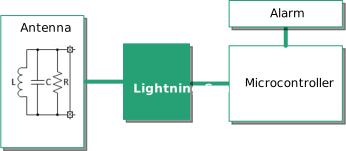
How our sensor measures lightning
The system uses a single tuned antenna to listen for the broadband radio pulse that every lightning discharge emits. When it hears a candidate event it checks the shape of the signal against the known signature of lightning, so man-made bursts from motors, switchgear and power lines are rejected as interference rather than counted as strikes. From the energy of the received pulse it estimates how far away the storm front is, and by watching how that distance changes it works out whether the storm is moving closer or away. Because it needs only one compact, low power sensor rather than a network of antennas, it is ideal for early warning at a single site, complementing the wide-area systems described below.
Key features
| [ Range ] | Detects lightning activity up to about 40 km away, well beyond what people can see or hear. |
| [ Flash types ] | Detects both cloud-to-ground and cloud-to-cloud (inter-cloud) discharges. |
| [ Distance ] | Estimates the distance to the storm front and tracks whether it is approaching or moving away. |
| [ Noise rejection ] | Distinguishes genuine lightning from electrical interference to suppress false alarms. |
| [ Low power ] | Low power listening suits solar and battery powered remote installations. |
| [ Telemetry ] | Event logging and telemetry to a cloud dashboard, with strike distance and activity history. |
| [ Warning zones ] | Configurable caution, warning and red alert distance rings with escalating alerts and an all clear. |
| [ Outputs ] | Optional indicator beacon and siren panel for on-site warning, plus SMS or email alerts to subscribers. |
How lightning is measured
Lightning is measured in several ways, from a rough personal estimate to national networks and satellites. The main methods are:
| Flash to bang | Count the seconds between the flash and the thunder and divide by three for the distance in kilometres (about five for miles). The length of the thunder rumble also hints at the length of the bolt. |
|---|---|
| Detection networks | National ground networks use several antennas spread many kilometres apart to triangulate each strike. Comparing the arrival time and strength of the radio pulse at each site pinpoints the location, current and polarity. |
| Space-based mappers | Optical instruments on geostationary satellites watch the flash from above, even in daylight, and track the frequency, extent and growth of storm systems. |
| Structural strike sensors | On buildings and wind turbines, sensors on the down-conductors use the magneto-optic Faraday effect to measure the actual impulse current and total charge of a direct strike, sending the data over fibre to a logger. |
Our sensor sits at the local end of this range: a single-site detector that gives early warning of an approaching storm, rather than mapping strikes across a region.
South African Lightning Detection Network (SALDN)
The South African Weather Service (SAWS) operates the South African Lightning Detection Network (SALDN), a sophisticated system featuring over 24 high-precision sensors spread across the country and the region. This network detects electromagnetic signals from cloud-to-ground lightning, providing real-time data to protect lives and vital economic sectors like aviation and energy. Our single-site detector complements a wide-area network like this: SALDN maps strikes nationally, while an on-site sensor gives immediate, local early warning where people are working.
Applications
| Worker safety | Mines, construction sites, ports and other operations where people work in the open and must be cleared before a storm arrives. |
|---|---|
| Public venues | Sports grounds, schools and outdoor events that need a clear, early instruction to seek shelter. |
| Aviation and agriculture | Airfield ground operations and farm operations that stop for nearby lightning. |
| Weather networks | Adding lightning activity to a weather station or monitoring network. |
Deploy a lightning warning system
We size, supply, install and support the system, including the warning outputs your site needs. Contact us for more information and to discuss deploying lightning detection and early warning →
Related: More technologies we build →
EED Data Systems · Home · WindRose V1 · WxLog V1 · Stratus · Contact
Copyright 2026 EED Data Systems. All rights reserved. Validate results before regulatory or safety critical use.